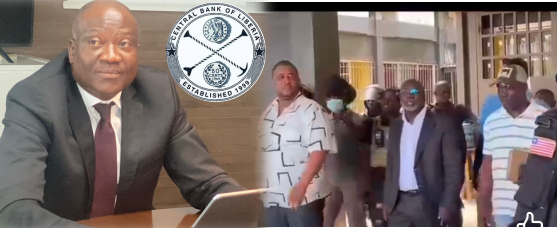

MONROVIA — A directive from the Central Bank of Liberia (CBL) obtained by FrontPageAfrica, has placed a freeze on the issuance of court bonds by commercial banks and insurance companies without prior written clearance from its Insurance Department — effectively preventing several lawmakers currently facing criminal charges, including former House Speaker J. Fonati Koffa, from securing bail.
By Selma Lomax, Selma.lomax@frontpageaffricaonline.com
The measure, issued on May 16, 2025, under Directive No. CBL/ID/DIR/00112025, mandates that any institution wishing to issue a court bond must first receive formal approval from the CBL’s Insurance Department.
The process requires insurers to submit notarized and certified audited financial statements, along with a full report of outstanding bonds issued prior to any new request.
The directive took immediate effect and has since disrupted the legal process for multiple lawmakers who were recently remanded into custody. These include Koffa (Grand Kru County), Abu Bana Kamara (Montserrado County District #15), Dixon Wlawlee Seboe (Montserrado County District #16), and Jacob C. Debee (Grand Gedeh County District #3). The four were incarcerated at the Monrovia Central Prison Saturday following their second court appearance in connection with a December 18, 2024 arson attack on the Capitol Building.
The lawmakers face charges of arson, criminal conspiracy, criminal facilitation, and attempted murder. Authorities claim the blaze, which caused an estimated $8 million in damages, was politically motivated and planned by senior officials, including Koffa, who allegedly used an aide to carry out the attack.
Under Liberia’s Constitution, all accused persons are entitled to bail, except in capital offenses or where flight risk is established. However, the new CBL directive has created a de facto denial of bail by halting the bond issuance process entirely, despite no court ruling denying bail to the lawmakers.
“No bonds have been filed because no insurance company is currently able to issue one,” said Cllr. Jonathan Massaquoi, legal counsel for the detained legislators. “The restrictions from the Central Bank have paralyzed the bail process.”
Massaquoi confirmed that his clients remain in custody not because of any judicial denial, but because no insurer is willing — or able — to navigate the new compliance burden in time.
Although the CBL’s directive does not reference Koffa or any specific individuals, legal and political observers say its practical impact points directly to the ongoing criminal case, which is increasingly being viewed through a political lens.
“This is no longer simply a criminal matter—it’s political,” said political analyst Sampson Wesseh. “The timing of the CBL directive, and its effect on sitting lawmakers, particularly those in opposition or critical of the current administration, is highly suspect.”
Wesseh added that the directive amounts to an indirect form of detention by financial decree. “When a regulatory agency with no judicial authority effectively blocks access to bail, we’re entering dangerous territory where the separation of powers begins to collapse.”
Other analysts echoed similar sentiments, suggesting the directive allows the executive branch to exert influence over the judiciary via financial institutions.
“If the Central Bank — intended to operate independently — is now involved in a case with political implications, it raises serious constitutional questions,” said one Monrovia-based legal scholar who requested anonymity.
The situation intensified over the weekend when the Monrovia City Court issued a Writ of Ne Exeat Republica barring all five lawmakers implicated in the case — including Rep. Priscilla Cooper (Montserrado County District #5), who has not been detained—from leaving the country.
The writ, granted by Stipendiary Magistrate Ben Barco, directs national security agencies to arrest any of the accused lawmakers attempting to exit Liberia.
While such writs are standard in major criminal cases, critics argue that, when combined with the bond restrictions, it underscores a coordinated attempt to detain lawmakers indefinitely without trial.
“This looks like a calculated legal and financial strategy to silence certain lawmakers,” said a human rights attorney. “It may be constitutional on paper, but it’s questionable in spirit.”
Repeated efforts by FrontPageAfrica to obtain a response from the Central Bank of Liberia have gone unanswered. A formal request for comment was submitted to CBL Executive Governor Henry F. Saamoi, seeking clarification on whether the directive was introduced in response to financial risk concerns or political pressure. As of press time, there has been no official reply.
As the bond impasse continues, the fate of the detained lawmakers remains unclear. Legal teams are reportedly exploring alternative avenues to challenge the directive or seek court intervention.
The post Liberia: Central Bank Accused of Targeting Former Speaker Koffa, Opposition Lawmakers Through New Insurance Directive appeared first on FrontPageAfrica.